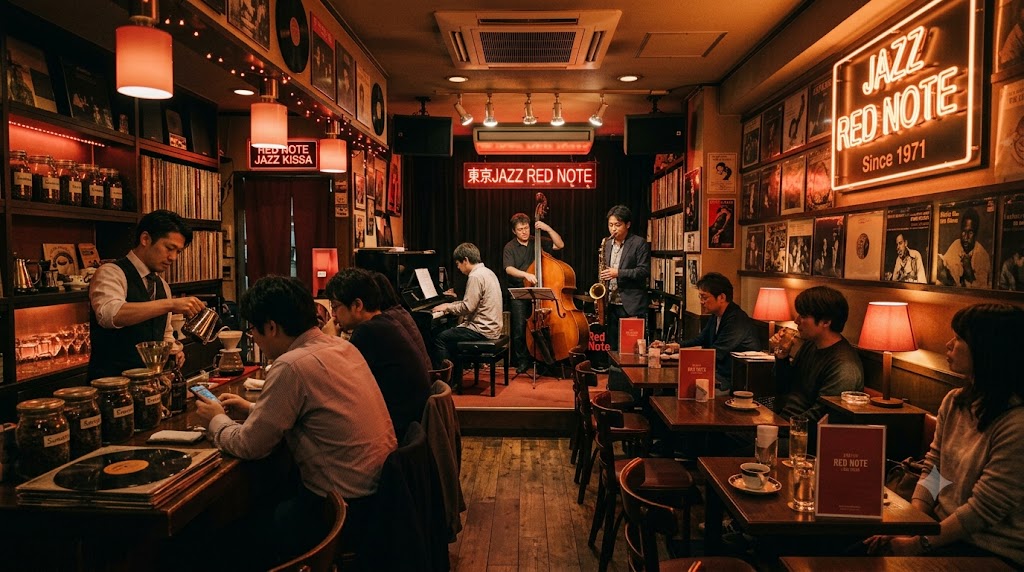
Noise dominates modern life. Notifications buzz, conversations overlap, and even music often becomes background filler. Tokyo’s jazz cafés push against that chaos with something increasingly rare: spaces built entirely around intentional listening.
These intimate venues strip away distraction and return music to the center of the experience. No loud chatter, no flashing screens, no spectacle—just warm vinyl crackle, carefully tuned speakers, and deep respect for sound. From their postwar origins to their minimalist design and strict listening etiquette, Tokyo’s jazz cafés reveal why Japan continues to champion the art of truly listening.
Tokyo’s Jazz Café Culture
Tokyo maintains over 200 dedicated jazz kissa venues where patrons pay JPY1,000–JPY1,500 cover charges specifically to sit in silence and listen to vinyl records through tube amplifiers. These refined listening spaces form a unique part of the city’s nightlife culture. Visitors and locals alike seek the focused atmosphere that sets jazz kissa apart from ordinary cafés or bars.
Three venue archetypes highlight this tradition. Meguro’s Bar Martha opened in 1968 and accommodates just 12 guests at a time. Koenji’s JBS offers only eight seats but houses a record collection exceeding 50,000 records. Shibuya’s Flapper, established in 1978, seats just 15 people and remains a beloved destination for serious listeners.
International attendance rises significantly during the November to March period. Research suggests seasonal traffic increases by roughly 60 percent during these months. Cooler weather seems to draw music lovers toward these warm, intimate spaces where analog sound becomes the main attraction.
Beyond hospitality, these venues serve an important cultural role. They preserve analog playback traditions while teaching younger generations the value of focused listening. In a world obsessed with speed and convenience, jazz kissa remain beautifully stubborn in their devotion to patience and sonic quality.
Historical Roots of Jazz Listening Spaces
Jazz kissa began in 1947 when Café Pacific in Shinjuku started charging entry fees to play imported 78rpm records during the American occupation period. This marked the birth of dedicated listening spaces where audiences came specifically to hear music—not merely as background noise, but as the main event.
By 1951, the first true listening bars emerged in Ginza. These spaces prioritized silence, attentive listening, and carefully tuned playback systems. Guests gathered not for conversation, but for immersion.
The movement expanded rapidly. The 1964 opening of Blue Note Tokyo introduced a larger-scale jazz venue with a 200-seat capacity. Meanwhile, record imports surged, with roughly 12,000 jazz LPs entering Japan monthly by 1968 to meet growing demand. A 1965 Asahi Shimbun survey recorded 75,000 daily kissa visitors, proving the practice had become deeply embedded in urban culture.
The peak came in 1975, when over 500 kissa venues operated nationwide. Many specialized in particular artists, labels, or jazz eras, building highly curated collections that attracted loyal regulars. These spaces laid the foundation for today’s jazz cafés, where music remains sacred and listening remains intentional.
Conclusion
Tokyo’s jazz cafés offer more than good music. They offer a different way of experiencing it. In these spaces, listening becomes deliberate, immersive, and almost meditative. The emphasis shifts from consuming music casually to engaging with it deeply.
That philosophy may be exactly why jazz kissa continue to thrive. They remind us that sometimes the best way to appreciate music is not through bigger speakers, louder rooms, or endless playlists, but through stillness, focus, and respect for every note.
As digital listening becomes increasingly fast and fragmented, Tokyo’s jazz cafés stand as a powerful reminder that music often reveals its deepest magic when we simply slow down and listen.
Would you trade a noisy modern café for a quiet room, warm vinyl, and uninterrupted jazz for one night? Stay tuned with DLK Lounge as we continue exploring the world’s most unforgettable listening cultures and the music spaces that shape them.
