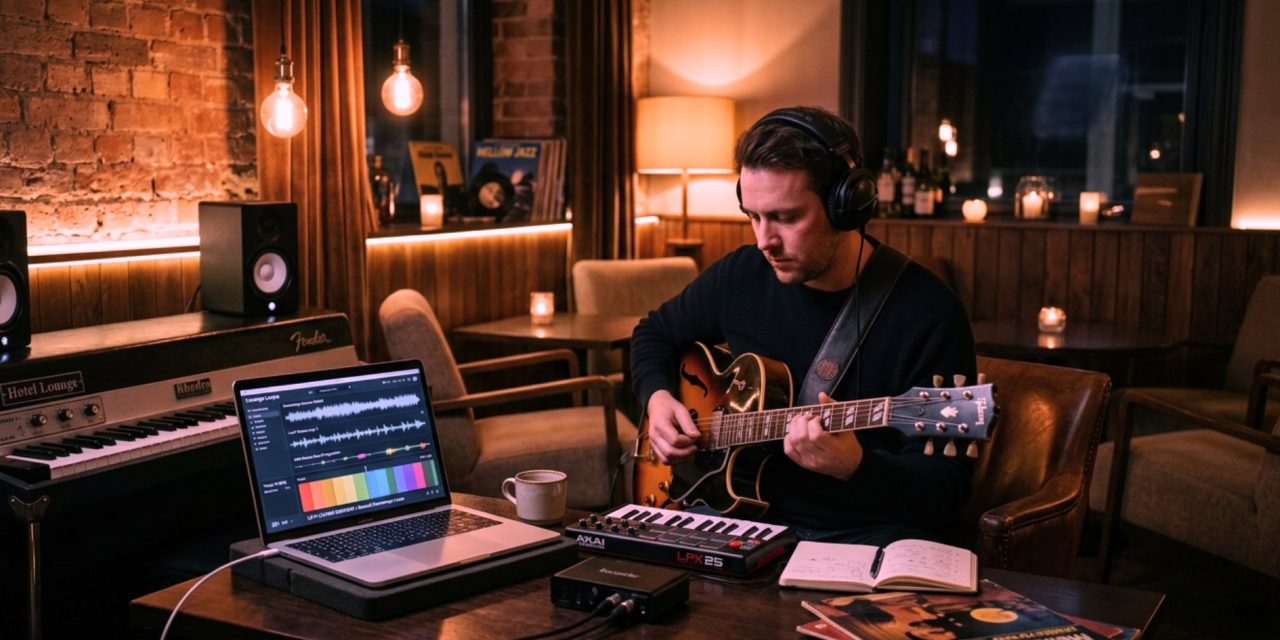
Finding the right backing track can feel like scrolling forever just to settle for “close enough.” One loop is too fast, another is in the wrong key, and suddenly your practice session turns into a search mission.
Now imagine this instead. You press a button and get a smooth, lounge-style groove in your exact key and tempo. Soft keys, warm bass, brushed drums, all sitting perfectly under your playing. No stress, no compromise.
That is what an AI backing band brings into your workflow. Tools like Suno.ai and Udio let you generate endless chill loops that feel like live lounge sessions. It is practice, but it actually sounds like music you would play in a café or late-night set.
Turning Practice Into a Lounge Session
AI backing tools shift your practice from mechanical drills to musical experiences. Instead of repeating scales over silence, you are playing inside a full, relaxed groove.
You can set your tempo precisely, whether you want a slow 70 BPM warm-up or a slightly upbeat 95 BPM lounge bounce. The consistency helps tighten timing while still feeling natural.
Key matching is where things really click. Choose a key like A minor or E major, and your loop aligns perfectly with your scales and chords. That means no clashing notes, just smooth harmony that supports your ideas.
The real magic is in the vibe. Generate lo-fi jazz chords, soft Rhodes textures, or mellow bossa-inspired rhythms. Add subtle reverb and delay, and suddenly your practice sounds like a chilled lounge performance.
This approach keeps sessions engaging. You are not just practicing technique. You are building musicality, phrasing, and feel in a setting that actually inspires you to keep playing.
Building Custom Lounge Loops That Fit Your Style
Getting started is simple, but the depth comes from how you shape your loops.
With Suno.ai or Udio, you begin by entering your tempo, key, and style. Try prompts like “downtempo lounge jazz with soft piano and warm bass” or “chillhop groove with airy pads.” Within seconds, you have a playable loop.
From there, you refine. Adjust loop length, add swing for a more human feel, or layer instruments like brushed drums, upright bass, or ambient synths. Small tweaks make a big difference in realism.
You can also export audio or MIDI for deeper control in your DAW. This lets you isolate instruments, tweak arrangements, or build full practice tracks tailored to your routine.
For guitar, jam over smooth chord progressions with subtle rhythm layers. For piano, explore voicings over lush pads and jazz chords. Drummers can lock into relaxed grooves, while bass players can follow and reinterpret laid-back lines.
The result feels less like practicing alone and more like sitting in with a quiet, professional lounge band that adapts to you.
Conclusion
AI backing bands are changing how musicians approach practice. They remove friction, add musical context, and turn repetitive drills into something enjoyable.
By combining precision with vibe, especially in a lounge-inspired setting, they help you develop both technique and feel at the same time. That balance is what keeps sessions productive without draining your creativity.
Instead of chasing the perfect track, you create it instantly. And when your practice sounds this good, showing up daily becomes a lot easier.
If your practice already sounded like a smooth lounge session, would you play longer or just play better?
Stay tapped into DLK Loungefor more creative tools and ideas that make your music process feel as good as it sounds.
