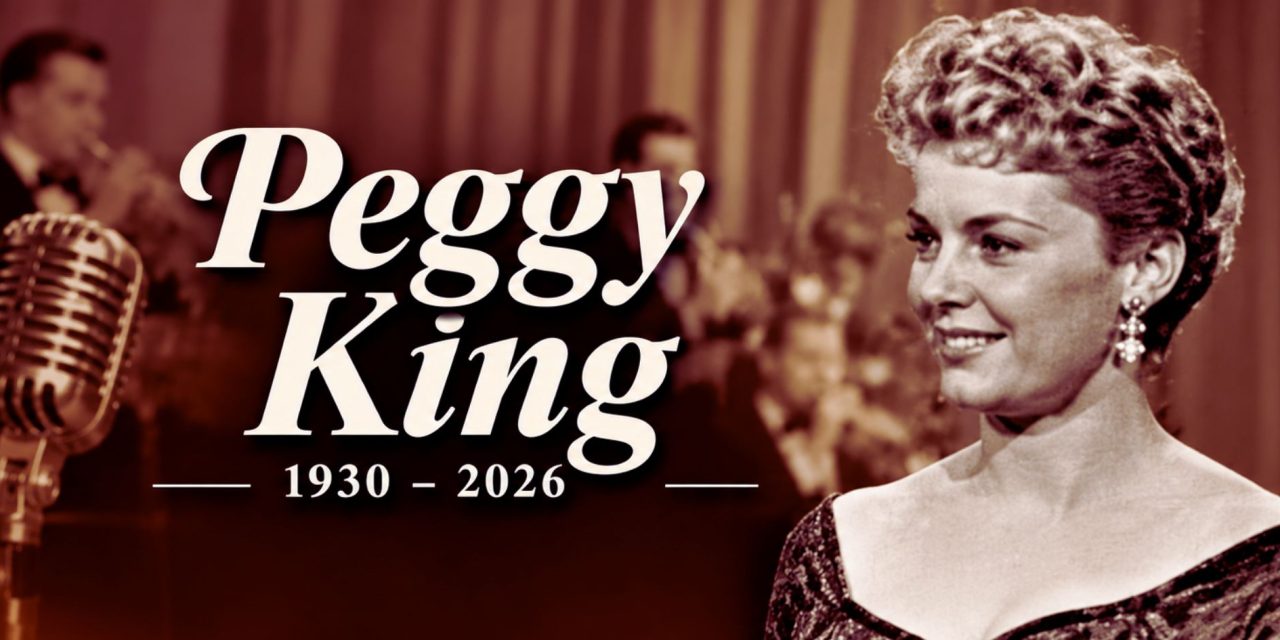
Peggy King, the jazz-pop singer whose career connected touring orchestras with early network television, died on October 25, 2026, at age 96. Her death was confirmed by publicist Alan Eicher, according to Variety. JazzWax’s Marc Myers also reported her passing, drawing on his 2015 interview with King and crediting drummer Bruce Klauber with alerting him.
Remembering Peggy King means revisiting a period when popular song, jazz musicianship, and television entertainment regularly intersected. Before audiences knew her as “Pretty Perky Peggy King” on The George Gobel Show, she had worked with major big bands and developed a career that extended into recordings, film, and variety television. Her story offers a glimpse into the working life of a singer who moved comfortably between musical and broadcast settings.
A Big-Band Education
Before becoming a familiar television personality, King worked with the Charlie Spivak, Ralph Flanagan, and Ray Anthony orchestras. In her 2015 interview with Marc Myers for JazzWax, she described how her big-band experience prepared her for the demands of live television.
Singing with an orchestra required more than delivering a melody. A vocalist had to work within an ensemble, follow the arrangement, and fit the performance into a larger musical structure. King later drew a direct connection between that experience and the pace of early television.
Her background also illustrates the close relationship between jazz and traditional pop during this period. Singers could work with jazz-oriented instrumentalists while performing music for mainstream audiences. The categories often overlapped, even when record labels and entertainment programs presented artists in different ways.
For listeners exploring King’s recordings, her big-band background offers a useful starting point. An archival performance can reveal how a vocalist interacts with the accompaniment, shapes a phrase, or enters after an instrumental introduction. Those are listening questions rather than assumptions about any particular recording; the performance itself should provide the evidence.
The Song Moves Onto the Screen
King appeared opposite Mel Tormé on television in 1952 before becoming a regular on The George Gobel Show from 1954 to 1957. Gobel’s writers supplied the nickname “Pretty Perky Peggy King,” which became closely associated with her television career.
Her work extended beyond singing. The show combined comedy, conversation, solo performances, and duets with guests. King recalled that she sometimes had to learn the day’s songs that same morning, reflecting the preparation required in a fast-moving broadcast environment.
Television also changed the relationship between performer and audience. Unlike a concert hall, where a singer addressed a room, a television appearance brought the performance directly into viewers’ homes. The format encouraged a familiarity while requiring performers to coordinate music, dialogue, movement, and timing.
King’s career demonstrates how singers became central figures in early network entertainment. Variety programs relied on performers who could move between musical numbers and other parts of a show. Her experience as both a singer and an actress suited that format.
Her television appearances also deserve consideration as part of her musical history, not simply as a footnote to her recordings. When exploring surviving clips, check the program, date, song, and accompanying musicians where those details are available. Such information helps place a performance in context.
Returning to the Recordings
King’s recording career offers another perspective on her place in popular music. After appearing on The George Gobel Show, she signed with Columbia Records under producer Mitch Miller. Her early album Girl Meets Boy (1955), recorded with singer Jerry Vale and the Percy Faith Orchestra, placed her voice within an orchestral popular-song setting.
The collaboration connects King’s television visibility with the recording industry of the 1950s. Albums and singles offered a different way to encounter a performer, separate from the personality and pacing of a television appearance.
Listeners can explore the recordings alongside surviving broadcast performances. A duet provides an opportunity to follow how two singers share a song, while an orchestral recording brings the relationship between the vocal line and the arrangement into focus. Television adds another dimension through the performers’ interaction and presentation.
King continued recording later in life. Her album Songs a la King appeared in 2016, decades after her early Columbia releases. The album provides another entry point for listeners interested in the longer arc of her career.
These recordings and broadcasts should be approached as complementary parts of her musical legacy. Rather than assuming that one format captures the whole artist, listeners can follow the different settings in which King worked and let each performance speak for itself.
A Place in the Lounge Listening World
DLK Lounge’s interest in vocal jazz and traditional pop extends to the performers who carried songs between stages, studios, and television screens. Peggy King’s career offers a clear example of that movement.
Her experience with big bands connected her to an ensemble tradition, while her recordings and television appearances placed her before broader popular audiences. Those paths were not separate careers so much as different parts of a working singer’s life.
King also resisted being remembered only through her television nickname. In the interview republished by JazzWax, she expressed a preference for being remembered as an actress who sings. That distinction captures the breadth of her work without reducing her to a single role or musical category.
A thoughtful remembrance begins with the performances and the people behind them. King’s recordings, television appearances, and collaborations provide several ways to revisit her contribution to mid-century entertainment. Exploring those materials with attention to their credits and context keeps the focus on the artist and the work she left behind.
When you revisit Peggy King’s recordings, what interests you most: her big-band roots, her orchestral pop songs, or her television performances?
Explore more stories about the voices, recordings, and musical eras that shaped vocal jazz and traditional pop on DLK Lounge.
