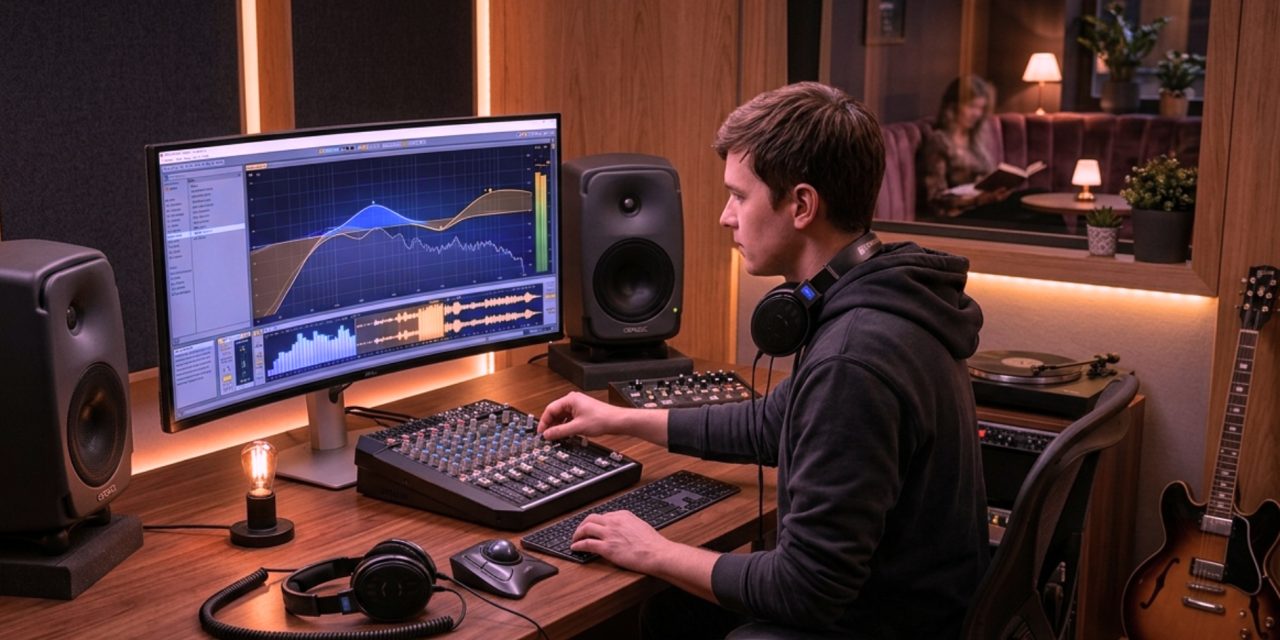
In lounge music, the goal has never been to sound the loudest or the sharpest. It is to feel effortless. The kind of mix that sits comfortably in the background yet still pulls you in when you pay attention. That balance—subtle but intentional—is what separates forgettable tracks from ones that quietly last for years.
The evergreen approach builds directly on that idea. Instead of chasing extremes, it focuses on proportion. A lounge mix should feel warm without becoming muddy, clear without turning harsh, and airy without sounding thin. When those elements are balanced correctly, the music translates naturally across spaces—cafés, headphones, living rooms—without losing its character.
At the center of this approach is a simple concept often described as a “golden ratio” of frequency balance. Roughly speaking, the low end carries the foundation, the mids hold the musical detail, and the highs provide air and openness. When these three areas are kept in proportion, the result is a mix that feels complete without drawing attention to any one part.
Golden Ratio EQ: Balancing the Lounge Spectrum
The low end, typically spanning from 20Hz to around 250Hz, provides the depth that gives lounge music its grounded, relaxed feel. Basslines, kick drums, and the lower registers of instruments should feel full, but never overwhelming. In a well-balanced lounge mix, the low frequencies support the groove rather than dominate it.
You can hear this clearly in Plan of Perfection, where the bass feels rounded and supportive rather than heavy. It anchors the track without clouding the harmonic movement above it—exactly the role low-end should play in a lounge context.
The midrange, sitting roughly between 800Hz and 4kHz, is where the music communicates most clearly. This is where vocals, chords, and melodic elements live. In lounge music, mids should feel present but never aggressive. The listener should be able to follow the harmony and emotion of the track without feeling like anything is pushing too hard for attention. Subtle shaping here makes the difference between a mix that feels natural and one that feels tiring.
High frequencies above 8kHz bring the sense of space that defines the lounge aesthetic. This is where cymbals shimmer, reverb tails breathe, and textures gain their softness. When handled carefully, the highs add polish and air. When overdone, they introduce harshness that immediately breaks the relaxed atmosphere. The goal is a gentle lift—enough to open the mix, but never enough to distract.
Loudness and Dynamics: Letting the Music Breathe
One of the defining traits of lounge music is its relationship with dynamics. Unlike more aggressive genres, lounge relies on contrast within softness. The music should move and breathe, not sit flat at a constant intensity.
Keeping overall loudness at a moderate level allows the details to remain intact. More importantly, preserving dynamic range ensures that the groove feels alive. Subtle differences between louder and quieter moments create a sense of flow that draws the listener in without demanding attention.
When dynamics are over-compressed, the result is a mix that feels small and constrained. In contrast, an evergreen lounge mix leaves room for movement, allowing each element to rise and fall naturally within the arrangement.
Spectral Balance: Creating Space Without Emptiness
A strong lounge mix is not just about what is present—it is also about what is removed. Clearing unnecessary low frequencies from non-bass elements prevents muddiness and opens space for the core groove. At the same time, avoiding overcrowding in the mids ensures that each instrument can be heard without competing.
This careful balance creates depth. Instead of stacking sounds on top of each other, the mix feels layered and spacious. Each element has its place, and the listener can move through the music without friction.
High frequencies play a similar role. Rather than pushing brightness, they should enhance the sense of air. A well-shaped top end makes the mix feel open and relaxed, reinforcing the calm, immersive quality that defines lounge music.
Consistency Through Reference and Listening
One of the most practical ways to maintain this balance is through consistent referencing. Comparing your mix to a range of well-balanced tracks helps keep your ears grounded. Not to copy, but to ensure that your low end is not overpowering, your mids are not buried, and your highs remain smooth.
Equally important is listening across different environments. Lounge music, more than most genres, needs to translate well at lower volumes and on everyday systems. A mix that only works in one setup misses the entire point of the style.
Conclusion
The evergreen approach to lounge mixing is not about strict rules. It is about developing a sense of balance that holds up over time. By focusing on proportion, preserving dynamics, and creating space within the mix, you build a sound that feels natural in any setting.
When done right, the result is music that does not fight for attention—but quietly earns it. That is the essence of lounge: not just something you hear, but something you settle into.
Are your mixes creating a smooth space people can live in—or just a moment that fades once the track ends?
Let us know in the comments, and keep refining timeless lounge sound only at DLK Lounge!
